
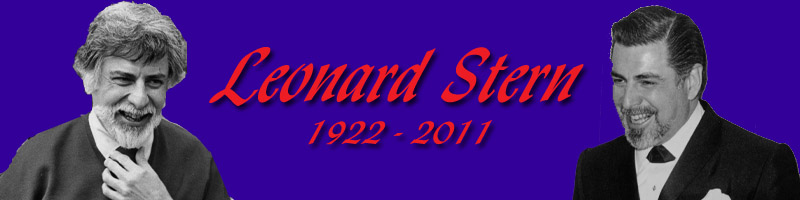
Leonard Stern, the guiding force behind Get Smart and so much more, passed away on June 7, 2011. I wrote the below mini-tribute on the day he died and I think it's a fitting tribute and has remained on my page ever since:

     I'd like to take some time to share some of my thoughts on the passing of our friend.

     News organizations will do a far better job than I on the impact of Leonard on the world at large. Suffice it to say that he, along with his friends and peers like Larry Gelbart, Norman Lear, and Sherwood Schwartz, created the prime time television industry that was so wonderful and creative until the past decade or so. It was the talent, drive, determination, and ethics of Leonard and his friends that created millions of wonderful moments that have enriched all of our lives. For the fans of Get Smart, the show never would have made it on the air without Leonard and it was Leonard who kept that quality up and fought for quality at every turn. Buck Henry and Mel Brooks created the show, but it was Leonard Stern who rewrote the pilot for the specific skills of Don Adams. While Mel left after the pilot and Buck after two seasons, Leonard was always there to guide the show and its cast and crew. Beyond Get Smart, Leonard created so much and gave so much it's impossible to count. You'll read elsewhere of the many careers Leonard helped get started, including Sherry Lansing, Stephen J. Cannell, Steven Bochco, Don Adams, Jay Sandrich, and Richard Donner. Those careers will shine the spotlight on Leonard, and deservedly so, but I'd like to write about the millions of non-famous people that Leonard touched.

     In his high school yearbook Leonard put as his goal "to make the world laugh." A pretty big goal but one that he achieved early on. Who among us didn't have their childhood enhanced by Mad Libs? Heck, Mad Libs taught me grammar better and in a more fun way than any teacher ever did. The laughs and fun we had sharing in the many hilarious moments he created in The Honeymooners, Get Smart, and his other work made our world better and also gave us something to share as a nation and as a world. I've traveled across the globe and I've always found someone touched by the work of Leonard. Many years ago, after we had first met, I asked visitors to this website to send a few lines about what Leonard's work meant to them and the results were staggering. A fan from Beirut who said the weekly airings of Get Smart helped him forget the war around him for a half hour, a woman in Atlanta who used the example of 99 to help her become a doctor, a businessman in Brazil who used Max's plea for niceness and fairness in his dealings, hundreds of fans who just learned to laugh and enjoy life while watching his work. A friend of mine, Tim K., told me how he used to watch the show with his brother and dad and how it helped the three of them bond. Now he's using the Get Smart DVDs to bond with his son. For every one of those stories that we know about, there are hundreds that we don't know about other than that they exist. The strength, morality, and humanity of the characters he shaped and wrote about helped many of us to become better people. And he made us laugh while doing it.

     On a personal note, I've had the privilege of being Leonard's friend and it's one of those instances where the person really does mean more than his accomplishments. When we first met, it would have been easy for Leonard to dismiss me, as I was just a guy who had a Get Smart website and at that time, web writers were looked down upon far more than today. Leonard treated me as an equal, with respect and dignity, right at the start and it's the measure of the man that he did that with everyone he met. We became friends and I don't know if he ever realized just how much he taught me. His humanity, intelligence, and caring came through on every level, whether we were discussing politics, dating, or the fan who yelled at me because I spelled "Goommee" wrong in Camp Gitchee Goommee Noonii WaWa. As a matter of fact, you've never had dating advice until you've received it from Leonard Stern! His ability to see what others couldn't and to do it all with humor and respect were unmatched. One time I was humorously recounting a difficult situation I was having in a video that I was producing and Leonard tossed off a solution that worked perfectly. It took him two minutes to solve a problem that I had been working on for a week. I only got to see him two or three times a year but those meetings were always the highlight of my year. The example of how he lived and thought inspired all those around him to be better. Writer/producer Alan Spencer said that not only did Leonard help him in learning how to produce a show, but also how to be a gentleman and that's true for so many of us. Most of us that were touched by Leonard don't have careers or accomplishments that will be trumpeted by the media when they discuss Leonard's wonderful life as the big names that I've mentioned. It's a shame really because the way that he touched us is actually more important than any of that, for Leonard helped so many of us to be better people and lead more enjoyable lives. The goodness, humanity, humor, and love of life that came through in all that Leonard did will always be with us to enjoy and use as guidelines and just plain laugh at life and ourselves. You did make the world laugh and you made it a better place because you made us better people. Goodbye my friend, though parts of you will always remain with us and guide us, you will be greatly missed. I'm already missing you because I know you could help me rewrite this ending to make it fantastic.


On May 2, 2000 I was fortunate enough to interview Leonard Stern about Get Smart and various other subjects. It was a fantastic visit, as Stern was warm, generous, and funny. I hope you enjoy reading this interview as much as I enjoyed conducting it.


Tell us about the origins of Get Smart.

The idea for Smart, Dan Melnick had wanted to do a spoof of James Bond, and he and David Susskind hired Buck and Mel. I don’t know who they hired first, but I should find out (laughs). They worked together to do a first draft script for ABC. ABC did not like the script and they sent me a copy and I thought it was a perfectly fine script. I was as equally bewildered as they were as to why they didn’t respond. We started to talk about some slight changes so that they wouldn’t feel that we weren’t ignoring them. Then Dan went back with that second draft and said, "if you don’t like this, you can have your money back." In twenty-four hours they called and said "okay, we’ll take our money back." Kind of unbelievable because it was just $7,500, not a real meaningful sum, although in those days it’d probably be the equivalent of $100,000 today. And we panicked. The market was closed, all the pilots were being made and then news came that NBC was looking for a show for Don Adams. We redesigned the show and I got involved in the rewrite and Dick Durso, who was the agent representing the show, would speak to me every day, "what have you done with the script?" I mainly just put the doors in because I didn’t know what else to change, I liked the script! I eventually put a few more jokes in, some more physical business, but essentially the show remained as it had been originally written. Then we had a meeting out here with Grant Tinker. He loved the script. Dick was so used to rejection and so the more Grant said he liked the script, the more Dick said, "don’t worry, Leonard has ideas to fix it." I thought they were old friends and that this was a routine they were doing. Finally I realized that they weren’t hearing each other. I started laughing and let them know they were on the same side.

I heard that Mel didn’t like to write things down and Buck was hired to write things down.

That is true, Mel likes to work with a group. He’s best when he’s performing the material. Matter of fact, we had a very long corridor you had to go down before you reached my office at the studio where we shot Get Smart. He and Mel would come in somewhere between nine-thirty and ten o’clock, but by the time Mel got to my office it was noon because he played all the offices first.

Didn’t Get Smart test poorly?

No. There were projected guesses. The only note I got from the network that was negative was that they felt that I had to get rid of Don Adams’ strident delivery. They felt the voice was an irritant. I don’t remember the date, but in about 4-6 weeks one of the astronauts imitated him on the initial flight when he said "sorry about that Chief" in Maxwell’s voice when something went wrong. No, they didn’t get a chance to test the show. What happened was, we didn’t make the pilot until all other pilots had already been made. We couldn’t finish the pilot in time to show it to the network. There was great enthusiasm about the dailies and they decided to put the show on the schedule, but they needed some film in New York for a meeting of the O&Os (Network owned and operated stations) and the affiliates. We had just finished shooting, so what I did is put a film together, an eight minute film, on Get Smart of the opening sequence, going into the phone booth. Then I had shot him returning to his seat, then he got another call, and he had to get up again and he went all the way back to the closet and there was another guy on the phone there, so he had to wait. We ended it there, so literally all the saw was the opening credit with the doors, the audience sitting in the Philharmonic, and the scene I just described. It competed with all the other pilots. By error, a newspaper man was there from the New York Herald Tribune, and he wrote a rave review on these eight minutes. Everybody was flying out to buy us, the sponsors wanted to see what we had available on movieola (a film editing device) and competed to buy time in it. So it never really faced any criticism except for that one suggestion.

What was the atmosphere like on the Get Smart set?

Everyone had a really good time, with the possible exception of Don. He was too apprehensive, too concerned, too afraid of having a good time for fear it might jinx them. But he didn’t interfere with the other people’s joy, he just removed himself. There was nothing comparable to it, so people sought us out to perform on the show. Especially gifted actors who knew there were roles for villains and we had to dissuade them from doing them comically. The very point you brought up earlier, please remain legitimate or you do us a great disservice.

One of my favorite is Vincent Price, he just was perfect in the role of the villain.

He understood. He knew that in the other films he could be flamboyant, here he had to be calm. It would be a clash of styles if he didn’t subdue his character.

How important was Ed Platt to the series? He had a great knack for making the ridiculous sound believable and absolutely normal.

He turned out to be irreplaceable. You very seldom say that about an actor but there turned out to be something innate in Ed, a paternal patience, that sort of harnessed this fury and made him reinvestigate his incredulity. Somehow, I think he had to be a results player and it worked out all right so he had to forgive the methodology. I sorely missed that. In the movies, there was no adaquete replacement.

He managed to convey that utter frustration, yet love for Max.

Yes. The equivalent, the other remarkable straight man with a comic sense was Paul Ford in Bilko. He was able to tolerate Bilko, he knew Bilko was behind every one of those nefarious schemes, but was never able to trap him.

And it never got to the point where it was ridiculous.

Right, they’re skilled players.

Did you work to create catchphrases in Get Smart?

It was a conscious decision that we should have them. That’s my training from The Steve Allen Show where "Hi Ho Steverino" and "Why Not?" existed. Don had come with "Would You Believe" and "Sorry About That Chief" was an accident, people just started to say it. I think the only one that we actually succeeded in doing was "Missed It By That Much." I guess there are many others, but I can’t remember all of them.

Was it a conscious decision to have Max and 99 marry or did it just naturally progress that way?

I think you’re always affected by marketing research, which I think does great disservice to creativity and is questionable at best. I think they then showed that the show was in some kind of decline and we had to do something to renew audience interest. So that became getting married. And so the subsequent year that had helped but now we’re once again showing signs of losing the audience, so why not have a child? We had already had a dog so we couldn’t look upon that as a saviour. I felt that there always are signs that you’re in trouble. I think the core audience was always loyal and might possibly been bombarded by having the children. I remember watching the Dick Van Dyke show, I was a great fan of it, and they had the boy. I felt he it inhibited them and I believe the felt the same way because ultimately he was always upstairs in his room or certainly off camera.

Did you have any problems with censorship or the network?

Credits of Get Smart with Leonard SternThere was no involvement at that time, it was relatively non-existent. They watched out for, justifiably, and licentious dialogue or bad taste jokes, but they didn’t get involved in story, except in a constructive way. It was a very easy way to work. The people were good listeners. I think Walt Whitman said it once, "What does a good poet need? A good audience." And that’s what they were at that time. The networks were not involved in the production. They would distribute it, so they could exhibit taste. There wasn’t that reliance on numbers, there was a visceral response that was meaningful. The only difference I see between voodoo and marketing research is that voodoo sometimes works! I’ve always felt that our decline, in terms of consistent, quality, television is the result of marketing research.

I couldn’t agree more, especially after reading "A Martian Wouldn’t Say That!" There seems to be a huge change in the role of the networks in the past thirty years.

Yes. You see, there’s no one around now who remembers what it was like in the past. In fact, Tom Murphy, a marvelous man, when he took over ABC, we had dinner together. I was explaining to him how it once had been. He was incredulous. I said, ABC had the most people involved, because everyone who was an executive got involved in the presentation and they voted as a group. CBS and NBC use to have four people in development, two on each coast, all empowered to say yes or no. They would consult, but you got an answer within forty-eight hours. Mr. Murphy then said, "I imagine you’re going to tell me how many people we have now?" I said yes, I didn’t want to be that transparent, but you now have 29 and they all have assistants and I think that’s the distinct difference. At one time there were eight of you and you made a decision in a very short time. Now there are probably cost to sixty of you and it’s labyrinthine. The person who makes the decision is seldom involved in the development.

I remember hearing how when Mel Brooks showed Blazing Saddles, the studio told him it was great, but marketing wanted them to take all of the racial references and jokes out of it.

Yes. They keep establishing what was, not what will be. They can’t. Their very system, the nature of it is such that you can’t explain a new idea to an audience. You’re asking them to be equally as creative and that doesn’t work in our business.

I get a lot of people commenting on the Cone of Silence.

Buck and Mel had that and I thought it was superb, and of course we did variations like the portable Cone and different malfunctions, so it was a great tool. We did discuss the design often because none of us had any preconceived notion of what it should look like, but the bubbles worked effectively. I did add what became the agent in the bizzare hiding places. In the original I put him in the locker in the airport and then suddenly it became "where can we put him?" Victor French was the original, he was 44, and then Dave came and got another number.

He told me his favorite was when you put him in the sofa with the beautiful girl.

Yes (laughing). I have a picture of that somewhere. I don’t have many Get Smart photos here, just that one behind the door of Max and 99.

What was the relationship like between Don and Barbara because they had such great chemistry on the screen?

I think they were both very professional. Very respectful of each other. Barbara was, and still is, a person who’s involved in words and language and thought. So when she was in her own time she was a prodigious reader and wrote poetry. And Don loved to mingle with his cronies and tell jokes, so they went their separate ways. But as I said, there was a great affection for each as a performer. I remember when we signed Barbara because she made such an impression on us in a commercial where she was lying on a tiger and it was a very sensual performance and we thought she’d be ideal. We had her under contract and we put her in a show in New York called Mr. Broadway with Craig Stevens. When we wanted Don to see who we felt was perfect for the role of 99 we ran this film for him. We had purposely shot it so that she would be able to be the role, but with another name. Don said, "My God, she’s taller than Craig Stevens!" But, to his credit, he admired her. She generally worked the show without shoes, or with a model’s slump, or bending her knees.

Everyone seems to talk about how wonderful she was to work with.

She’s just a total professional. She regarded this as work and she had to be proficient at it. She didn't have the emotional luggage that most performers bring to the set.

I think most comedians have some form of baggage, whereas Barbara was an actress, not a comedienne.

Yes, Don had his quota of angst.

It seems like it was that way with Jackie Gleason too, another great talent.

Generally, comedians are at war with their writers because of the dependency on them. Both Don and Jackie had one thing, they knew they needed good writers. When there were good writers involved, no matter how frustrated they were, they would never exercise any of their wrath on writers (laughs). They’d avoid that, especially because they respected them. In fact, Gleason was the antithesis of his image. He never saw a script earlier than the night before the show, and very often the morning of the show, because he had total recall, a photographic memory. That meant he had to say what was written. He just wanted to make sure that he had the best writers and once he was sure, I think in the four years, he only twice questioned a script. It didn’t make him happy that he was that dependent (laughing). He didn’t actually want to socialize with you, but he recognized your importance to his survival. Don was more convivial with writers because he wrote himself. If he went into that mode, he could identify.

One of the most popular bits in the show was the villain, The Craw. I wonder if it’d be possible to get a character like him through the censors today.

I don’t think so. It’d be politically incorrect. I think we do a disservice to comedy when you arbitrarily impose those conditions. If you realize that he’s of another era and it was a problem, it might be acceptable, but there’d be nobody to argue the case with because the networks would not want to offend. I can’t disagree, but yet it’s memorable, and we didn’t get a single letter of protest. Today there would probably be organized protests.

I heard from Leonard Strong’s (the Craw) daughter and she said he loved the role.

It wasn’t intended to denigrate and it was an exaggeration of the trust, which is the whole show. But times have changed, whether for better or not, in terms of comedy, it has to be weighed, yes.

We’re all looking forward to having Get Smart back on the air soon, but we aren’t looking forward to how they cut three minutes or so out of every episode.

It’s a monumental disservice to the flow of the show because you constructed it conscientiously and meticulously to work and you don’t picture someone emasculating it. There’s a show, one of my personal favorites because of the premise, is where they invade the communist cell and they discover there are no communists in the cell (Double Agent). It’s just members of every intelligence service that are maintaining this subversive organization. I like that one.

Do you have a favorite episode?

I have a great affection for the pilot because it’s historic and I enjoyed the one Buck and I did, Ship of Spies, but it’s like having children. It’s hard saying "this is my favorite." I did a movie, Columbia was going to do a Get Smart movie and I wrote, and then they reneged and that became the three-part A Man Called Smart, which I’m very happy with.

That’s got one of the more memorable scenes when they’re trying to take Max, who’s strapped to a stretcher, through a revolving door.

It had been a marvelous sequence in the movie which we couldn’t afford to do on television because he never gets out of the stretcher. He went through all of San Francisco, just up and down hills. He had just enough momentum to go back up a hill each time he plummeted. The physical things in it needed rehearsals and orchestrations because they were condensed in the show. One joke, the error of how we shot it, remains indelibly etched in my mind. Isn’t that funny? That’s where he’s getting a lift at the movies. He comes onto the movie lot and he speaks to someone he knows who has a car and he has to take everything out of the front of the car and put it into the back seat. He gets in and he says, "Where are you going?" "Stage 8." And he drives about a foot and a half and lets him out. By error, they cut. You have to just stay in that same shot because if you cut it could be ten minutes later! I couldn’t believe it when I saw it and we couldn’t afford to go back and re-do it. There was another show, memories are coming back, where we had to get someone slightly inebriated (The Reluctant Redhead), but we only shot them with one drink. So we had to edit the film so it looked like she had many drinks. We had to do it with some technique, so we used a music box to cut it so that it looked like she went from sober to slightly high, which was important to the plot. Another one, the wedding (With Love and Twitches), we never shot the bride’s side so we had to go back and fake that.

How did the Nude Bomb come about, especially without Barbara Feldon?

She wasn’t desirous of doing the movie. For her, the show was over. The Nude Bomb is something that disadvantaged all of us that were connected with Get Smart. Originally, Arne Sultan, Bill Dana, and I had an idea that we found delicious. A couturier, a foppish man with an insane fiendish desire to control the world, but not for the power and money, but for the idea that he could dress every single individual and become an international name. The Earth would be designed by him. It seemed marvelous if we could get the right flamboyant actor. It was never called The Nude Bomb, it was called The Return of Maxwell Smart. Then it got into the hands of people who simply did not want, and I can’t explain why, to duplicate the television show. They wanted to do it differently. I kept saying to them, well why did you buy it? Just leave it alone to rest in its present glory. It then became a battle of trying to maintain the integrity of Smart but not being welcome on the set. The director (Clive Donner) was a good director, but he was used to doing intimate films, was a strange choice. As was Vittorio Gassman as the flamboyant, possibly homosexual designer.

How did Get Smart Again come about?

I guess we were all desirous of redemption of some kind of sort. It was felt that it should be a movie and we could reunite everyone. Initially they started to develop a script without our participation and then it was realized it was going in the wrong direction so we joined forces. I don’t remember quite how that happened, but ultimately all of us that were on the original worked on this and it’s a fairly good film.

My highlight of that is seeing Don work with Harold Gould.

Harold is marvelous. I’ve worked with him many times. In one series I did, He and She, he became Dick Benjamin’s boss and Alice Ghostley was his wife. I remember I delighted in calling them Norman and Norma so whenever you said either name, they both said yes. Harold was very good in the takeoff we did, where the man hunted humans.

Get Smart seems to have a difficult time getting on in syndication.

Yes, I have a theory about that. I haven’t voiced this before. I think there’s a great deal of violence in Get Smart. I tried to modify it as much as I could. But everybody got lost in the ambience. We’re an organization fighting to survive "let’s beat up the bad guys", whatever mentality that is. While we edited out a great deal, there’s still guns, there’s fights, and, I’ve always hoped, comic violence, but maybe that is unachievable in a sense that you can dilute violence. It may be an anachronism, or an anomaly in this time and when we have a healthier nation and we don’t have these vicious happenings, perhaps the audience will be comfortable with it again. I was concerned about that, and unduly concerned as it turned out to be, when we were doing it. And there wasn’t this parental concern being exhibited then that’s very prevalent now and maybe it’s affected or frightened the people who program. The reason I imagine it hasn’t been put on videocassette is that they want the accompanying publicity of the show being on the air and so I think you will see cassettes when the show returns to cable or whatever outlet, maybe even the Internet!

People were outraged when Get Smart was ignored during the Emmy Anniversary Telecast.

It’s interesting and I don't know why. There is a new spy show being created apparently. It has some agency initials. I don’t know if it’s any good or not, but they’re attempting to revive the spy comedies. (Stern is referring to HUD, a failed pilot that starred Steve Carell)

I think the general sense is why are they doing this when Get Smart did it better?

You made a sagacious observation before. The successes of Smart will be in the legitimacy of the personnel in charge of the agency. You need validity. You have to believe that the agency works or functions and that it’s not a cartoon organization. They had a problem with that movie (Top Secret), with the very gift men, the Zuckers, and they didn’t have a legitimate head and the enemy was cartoon characters and did a great disservice to some very imaginative moments.

I thought the Fox series would have worked with 99 as the Chief. No one would ever believe that Max became the Chief.

It sounded like a good idea in the beginning. Don could have played the Chief, but he would have had to abandon Maxwell. He can be disbelieving and disdainful with consummate skill, but that isn’t Maxwell. Maxwell would buy into most of the absurdity.

Tell me some more about yourself. How did you get into comedy television?

I was very fortunate when I got started. I was still in school and I wrote jokes for Milton Berle and traveled with him. Wherever he went, so I could write material that was indigenous to our surroundings. That’s great training. Then the war came along and I ended up doing half hour programs that were ultimately turned into recruiting programs. But they treated them as legitimate half hour comedies and dramas and dropped the commercials. We had available to us every star on Broadway and anyone who came East from Hollywood, so I had great on the job training. After the war, Martin Ragaway, with whom I’d gone to school and who had not been in the service, had established a reputation in New York as a comedy writer and I joined him. We became partners and we did shows in New York. That led to our coming out here and we did Abbott and Costello radio programs and Abbott and Costello movies and Ma and Pa Kettle movies. By the time television arrived, I was writing on my own and doing musicals. Somehow, whatever you did last becomes what you do best! Television then invaded the movies territory and frightened them into curtailing production dramatically. I think they were doing ten percent of the productions that had been done before television. There wasn’t work out here and I was very fortunate, a job opened up on the Honeymooners, so I moved back East and spent four years on The Honeymooners. Then a year with Bilko and four years with Steve Allen as head writer and director. By the time I came back out here (LA) I was established. I was able to create what is still one of my favorite shows and I’m very prideful of the reviews it received, that was "I’m Dickens, He’s Fenster." It also brought me in touch with Stan Laurel, who wrote me a fan letter. I couldn’t believe he sent it so I disregarded it until Steve Allen said, "didn’t you ever hear from Stan Laurel?" I thought Steve had written it because they all knew that I loved Laurel and Hardy. It turned out that when Steve was interviewing Stan Laurel he had asked him if he had watched television. Laurel said that there was one show he watched regularly and he had written the writer a letter but had never heard back from him. So Allen said maybe he knew him and it turned out to be me!

I’ve heard amazing things about that show, but it’s impossible to find anywhere.

I don’t think anybody has copies of it, but me. When I’m in my Machiavellian mode, I think, "gee, could I retitle it and sell these scripts again?" Just remake them, how many people will remember? It was derivative in the sense that it dealt with blue collar workers and I trained by working on the Honeymooners, but it was unique in many ways that I didn’t realize. A, we had a single man who envied a married man his life and the married man envied the single man’s life. B, we had the first working wife in television. And we dealt with issues, but they were subtext and you weren’t aware until you had a retrospective, that you had hopefully just learned something and we made a significant statement. The preoccupation with winning that exists here in America. A terrible concept and we dealt with that. The destructive nature of people. We had people beating each other up over whether a joke was funny or not. We actually had an "It’s Funny" group going up against a "It’s Not Funny" group with placards and signs and that kind of madness, so the show had many levels.

I’ve always wanted to see it. I finally got to see some episodes of the Partners (thanks Pete), but I’ve never seen I’m Dickens, He’s Fenster.

I remember The Partners only because I contributed a physical joke. They needed a piece and I had been driving across Coldwater Canyon when I saw a cantilevered house. They’ve very dramatic because they’re literally on stilts, above a ravine. It’s unnerving and so I suddenly had a vision of Don and his partner knocking on the front door. There’s no answer and they race around to the back of the house. I think Gary Nelson did it, they shot it beautifully, those two bodies just shot through the air! I don’t know how they did it, but it was most effective.

One of the things in Get Smart was that 99 was really the first career woman, actually second after Kate Dickens (I’m Dickens, He’s Fenster).

That may be part of my heritage or my instincts, or my mother proselytizing. Talent Associates hired women as executives and many well-known executives came from Talent Associates, including Barbara Schultz, Sherry Lansing, and others, it’s a very impressive list. We were the beneficiaries of that policy because we hired gifted people that were simply not offered work anywhere else. Remember, in the pilot Max thought 99 was a man, so even that was easing her into the workplace.

I have several women who have expressed to me how 99 was their role model.

It’s interesting. You don’t realize the impact. I haven’t thought about that at all. You never realize what’s going to endure. Over 40 years ago Roger Price and I created a word game, Mad Libs, and I’m still writing it. I’m sitting at my typewriter doing Mad Libs in Love for next year and I have to put myself into a different mood and just get rid of all the polysyllabic words in me. Who figured that when we did that it would last this long? The Honeymooners is still around, Get Smart resurfaces a lot and MacMillan and Wife is still on and that’s 25 years now.

People ask me why did Get Smart work and I say it’s because it’s one of those instances where you get such a great combination of people working together.

We had good fun, we really did.


Copyright 2011 Carl Birkmeyer